Welcome to the homepage of the Graduate College 'The Economics of Innovative Change'
The Graduate College 'The Economics of Innovative Change' is a distinguished PhD programme in Economics, offered by the Department of Economics of the Friedrich Schiller University in Jena, Germany. The programme results from the former DFG Research Training Group 1411 which has been financed by the German Research Foundation from 2006-2017. We offer a comprehensive PhD-level training to 10-15 outstanding young graduates. The programme is international and highly committed to quality in teaching and research. All academic activities of the PhD programme are conducted in English.
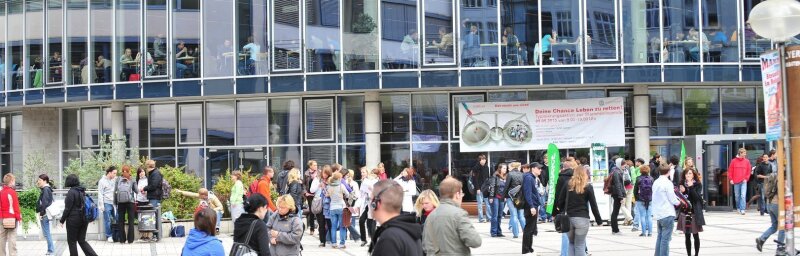
The programme
The PhD group hosts doctoral candidates from the Friedrich Schiller University Jena which are financed by the university or by external scholarships e.g. DAAD, CSC. The PhD students are expected to complete their PhD projects within around 3 years. The first year is devoted to improving the theoretical knowledge and competences, while the second and the third year concentrate on the dissertation-related research. The programme offers a 2-week summer school each year. The programme serves as a platform for collaboration, as a facilitator of joint scientific activities, and as a forum for knowledge exchange. It also provides senior expertise for junior research training in all necessary areas of competence: thematic, methodological, and transferable skills such as networking, scientific management, time management, and career planning.
Research Topics
Allowing for a broad concept of "innovation" we address a wide range of topics: industrial dynamics; entrepreneurship; innovation decisions and behaviour; competition, cooperation and strategic interaction in innovation; innovation in the development of consumption and consumer behaviour; human capital, skills and employment; innovation and regional development; innovation and economic dynamics of developing countries; energy, environment and innovation; innovation policy, and innovation management. The analytical approaches we pursue range from theoretical and empirical modeling, game theory, simulation analysis to experimental economics.
Courses
Through methodological and theoretical courses the programme deepens the capabilities of our PhD students to conduct a world-class research in economics. The courses are proposed both by the faculty and by the PhD students. Additionally, we allow our PhD students to participate in methodological and theoretical courses offered by the Central German Doctoral Program in Economics (CGDEExternal link) a joint programme by the universities of Dresden, Halle, Jena, Leipzig and Magdeburg.
Seminars
Wednesdays are seminar days. Our PhD students are welcome to invite distinguished scholars from all over the world to present their current work and discuss it with the group. At least once a year the PhD students present their own dissertation progress. Their work is then discussed and refereed by peers and senior researchers. Please visit our calender with external-guest seminars (JERS) and PhD-student Seminars (JERW).
Research environment
The PhD group shares the capabilities, the resources, and the facilities of the University in Jena de. Additionally it is integrated in an environment of related graduate programmes in social sciences. The Graduate AcademyExternal link is further dedicated to supporting PhD students with additional advice, courses, and financial aid.
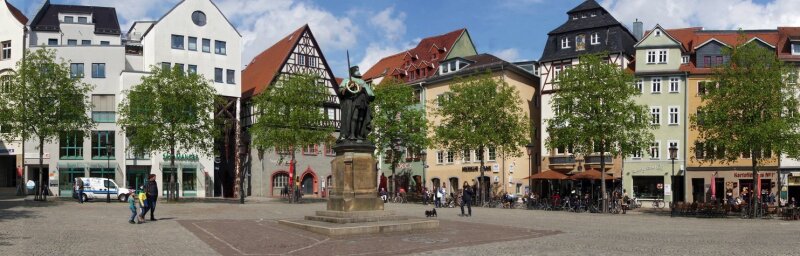
Jena
You are not the first historically important person who decided for the educational excellence of the 450-year old University of Jena. Philosophers such as Shelling, Hegel, Schopenhauer, and Schiller, mathematicians such as Leibniz and Frege, and physicists such as Abbe studied and worked in Jena.
Today Jena is a lively city with a strong presence of students and researchers. Besides the University, Jena hosts 3 Max Planck Institutes, a Fraunhofer Institute for Applied Optics and Precision Engineering, a Leibniz Institute for Age Research, and a University of Applied Sciences. The historical presence of companies such as Carl Zeiß and SCHOTT make Jena a world center of optics research. Check what Jena can offer for you todayExternal link.